Law report No. GLW-8563 · filed October 16, 2026
ArbitrationReported case
Court Upholds Unilateral Arbitration Clause in a Deed
A court has upheld a unilateral arbitration agreement in a deed, confirming one-sided clauses can bind where no consideration is required.
By Sophie Lindqvist3 min read658 words
Holding
- A court upheld a unilateral arbitration agreement contained in a deed
- The decision was reported by Lexology under the headline 'Court upholds unilateral arbitration agreement in a deed'
- A deed requires no consideration under common law, insulating the clause from reciprocity challenges
- The ruling shifts litigation risk onto the party without the arbitration option
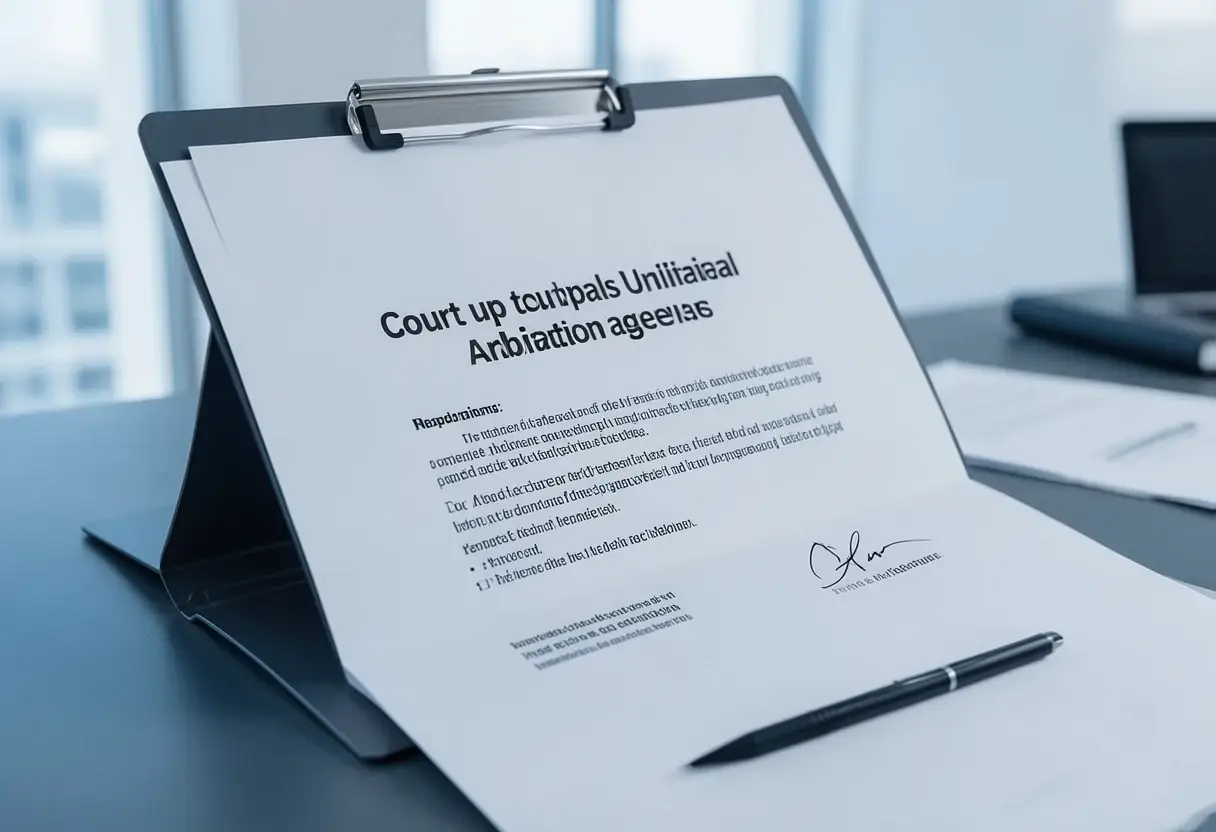
A court has upheld a unilateral arbitration agreement contained in a deed, according to a report published by Lexology. The decision confirms that a clause letting one party — but not the other — choose arbitration can still bind both sides when it sits inside a deed (a signed, sealed instrument that carries heightened formality and enforceability under common law).
The headline holding is simple. The court enforced the clause as written. It did not rewrite it to make it mutual. That outcome matters for anyone drafting property documents, commercial deeds, or settlement instruments.
What is a unilateral arbitration clause?
Most arbitration clauses are bilateral. Both parties agree to arbitrate disputes. A unilateral clause works differently. It gives only one party the option to elect arbitration. The other party must accept that choice.
Courts in several common law jurisdictions have long treated these clauses with caution. The objection runs like this: if only one side can invoke arbitration, the agreement lacks reciprocity, and consideration (the bargained-for exchange that makes a contract enforceable) may fail. Some courts have voided such clauses on that basis. Others have upheld them.
This decision falls in the second camp.
Why does the deed format matter?
The instrument's form did real work here. A deed is not an ordinary contract. Under common law principles, a deed does not require consideration to be binding. It needs execution with the required formalities — signature, and in some jurisdictions, sealing or delivery — and nothing more.
That single feature changes the analysis. If consideration is unnecessary, the absence of reciprocity stops being fatal. The party arguing against the clause cannot say "I gave nothing and got nothing arbitration-related in return." The deed binds regardless.
Think of it as a lock compared to a latch. A contract's consideration is the latch — push on it hard enough and it may give. A deed is the lock. Once the formalities are satisfied, it holds.
What does the ruling change for practitioners?
For drafting lawyers, the practical consequence is straightforward. If a client wants to preserve a one-sided option to arbitrate, placing the clause in a deed rather than a simple contract materially improves its survival odds. The deed format insulates the clause from the reciprocity attack that has sunk unilateral arbitration agreements elsewhere.
For litigators, the lesson cuts the other way. Challenging a unilateral clause inside a deed on consideration grounds is likely a losing argument in a court that follows this approach. Better targets exist:
- Whether the clause's scope actually covers the dispute in question
- Whether statutory unfairness or unconscionability doctrines apply, particularly in consumer or small-business contexts
- Whether the deed itself was properly executed and delivered
None of those routes is guaranteed. But they at least engage live legal questions, unlike a consideration challenge that the deed format forecloses.
The wider picture
Unilateral arbitration clauses appear most often in documents where one party holds structural power: standard-form finance documents, property deeds, settlements, and guarantees. Regulators in some jurisdictions, including Australia's securities and consumer bodies, have criticised them as unfair contract terms. So the enforceability question is not purely technical. It distributes real litigation risk.
A court willing to enforce such a clause in a deed shifts that risk onto the non-electing party. That party can be forced into arbitration without ever having agreed to a mutual forum. It can also lose access to a court, to precedent, and to the procedural protections a public forum provides — while the other side keeps all three available as a strategic choice.
The bottom line
The decision, as reported by Lexology, confirms a simple drafting proposition with significant consequences. Deeds can carry unilateral arbitration obligations that ordinary contracts might not sustain. Practitioners on the drafting side should take note. Practitioners on the challenging side should adjust their strategy accordingly, because the consideration argument — often the first one reached for — is off the table.
By Sophie Lindqvist
via GN Lexology (Source)
More from Sophie Lindqvist
Show full bio
News editor covering people, launches and day-to-day practice in International law and legal practice at Global Law Wire.
273 articles
Also before the court
- Supreme Court Reopens Federal Courts After Stayed Arbitration
- India's Supreme Court Reiterates: Arbitrators Cannot Rewrite Contracts
- Appeal Court Restores Contested Parts of Franchise Arbitration Award
- When Do Arbitral Awards Bind Third Parties in Australia?
- Supreme Court: Federal Courts Keep Power Over Arbitration Awards